


A few days ago, a woman in her early forties asked me something very directly.
“Doctor, everyone is saying different things. Some say surgery. Some say radiation. Some say chemotherapy. Which is actually the best cervical cancer treatment in Bhubaneshwar?”
This confusion is common. And understandable.
When someone hears the word cervical cancer, the next question is almost always about treatment. What works. What is necessary? What can be avoided? What comes first?
The truth is simple, even if it feels overwhelming at first.
There is no single “best” treatment for cervical cancer.
There is only the right treatment for your stage, your body, and your situation.
First, what decides the treatment for cervical cancer?
Before choosing between surgery, radiation, or chemotherapy, we consider a few key factors.
- The stage of cervical cancer
- Type of tumor
- The size of the tumour
- Whether it has spread beyond the cervix
- Age and overall health
- Whether fertility preservation is a concern
This approach is not guesswork. It is based on international treatment guidelines.
So when patients ask, “Doctor, which treatment is best?”, my answer usually starts with another question.
“How early is the cancer? Treatment depends on how long it has spread.
Cervical Cancer Treatment Options in Bhubaneswar
When surgery is the main treatment
Surgery is often the first choice when cervical cancer is detected early.
This usually applies to:
- Very early-stage cervical cancer
- Cancer confined to the cervix
- Small tumors
In such cases, surgery can remove the cancer completely.
Depending on the stage, surgery may involve:
- Removal of part of the cervix
- Removal of the uterus (hysterectomy)
- Removal of nearby lymph nodes
One of the most searched questions online is:
“Do all cervical cancer patients need a hysterectomy?”
The answer is no.
Not everyone needs the removal of the uterus. In selected early cases, fertility-sparing surgery may be possible. This depends on tumour size, type, and careful evaluation.
Surgery works best when cancer is localised. Once cancer has spread beyond the cervix, surgery alone is usually not enough.
When radiation therapy becomes important
Radiation therapy is a widespread and effective treatment for cervical cancer.
It is often advised when:
- Cancer is locally advanced
- The tumour is large
- Surgery may not remove all the disease safely
Radiation destroys cancer cells in the cervix and surrounding tissues.
Many patients ask:
“Is radiation better than surgery for cervical cancer?”
The answer depends on the stage, not the preference.
For many women with stage 2 or stage 3 cervical cancer, radiation is the primary treatment, sometimes combined with chemotherapy.
Radiation may be given as:
- External beam radiation
- Internal radiation (brachytherapy)
Both are planned carefully to target cancer while protecting nearby organs as much as possible.
Where chemotherapy fits in cervical cancer treatment
Chemotherapy is often misunderstood.
Patients often ask:
“Does chemotherapy cure cervical cancer?”
“Is chemotherapy always needed?”
Chemotherapy is usually not given alone in cervical cancer.
It is commonly used:
- Along with radiation (called chemoradiation)
- To make radiation more effective
- In advanced or recurrent disease
In chemoradiation, chemotherapy acts like a sensitiser. It helps radiation work better on cancer cells.
In advanced stages, chemotherapy may also be used to control the disease, reduce symptoms, and improve quality of life.
So chemotherapy is not a backup option. It is a strategic part of treatment in the right setting.
Surgery vs radiation vs chemotherapy. How doctors decide
Patients often want a clear comparison.
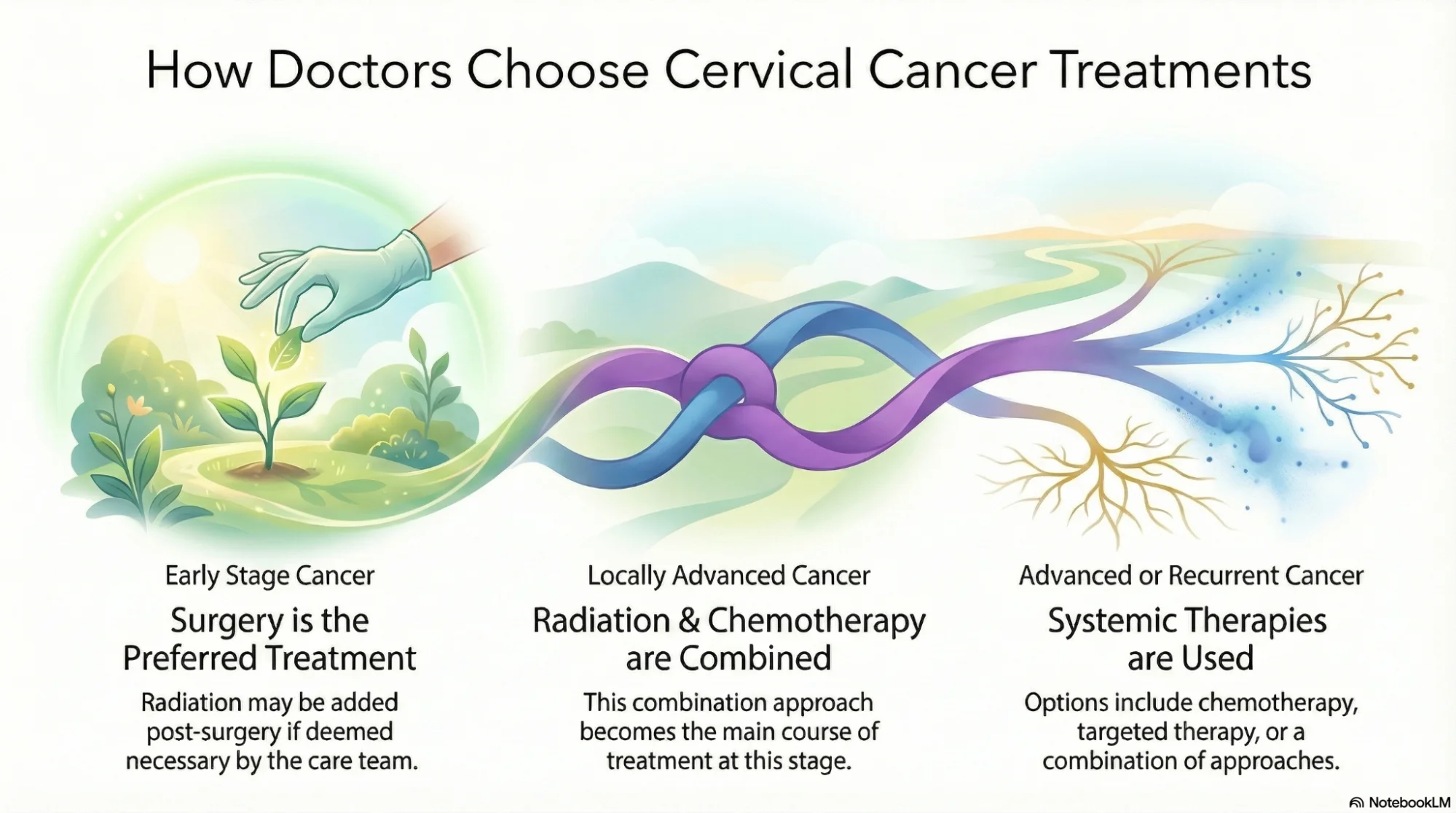
This decision is never rushed. It is discussed in detail, sometimes in tumour boards, to choose the safest and most effective path.
Side effects. A common concern
Another frequent search is:
“What are the side effects of cervical cancer treatment?”
Every treatment has side effects. But not everyone experiences them the same way.
- Surgery may involve recovery time and temporary discomfort
- Radiation can cause fatigue, skin irritation, or bladder and bowel changes
- Chemotherapy can cause nausea, hair loss, or lowered immunity
Most side effects are manageable and temporary. Supportive care plays a significant role during treatment.
I always tell patients. Treatment is not just about removing cancer. It is also about helping you get through it safely.
Life after cervical cancer treatment
This question often comes later.
“Doctor, will life feel normal again?”
In many cases, yes.
Recovery depends on:
- Type of treatment
- Overall health
- Emotional support
Many women return to work, family life, and routine activities after treatment. Follow-up care is essential. It helps detect any issues early and supports long-term health.
Concerns about intimacy, menopause, or fertility are real. These conversations matter and should never be rushed.
Why specialist-led care matters
Cervical cancer treatment is not just about choosing surgery or radiation.
It is about:
- Correct staging
- Proper sequencing of treatment
- Managing side effects
- Coordinating care across specialities
For women seeking cervical cancer treatment, being treated by a trained Gynecologic Oncosurgeon in Bhubaneswar ensures that decisions are aligned with global standards and individual needs.
Experience matters. Planning matters. Timing matters.
So, is there a fixed sequence for Cervical Cancer Treatment in Bhubaneswar?
No fixed order like:
Surgery → Radiation → Chemotherapy.
Instead, it works like this:
- Early stage, one organ affected
→ Surgery first - Cancer spread locally
→ Radiation + chemotherapy together - Cancer spreads further or returns.
→ Chemotherapy ± other treatments
Doctors decide this based on:
- Stage
- Tumor size
- Spread
- Patient’s health
Not personal preference.
A reminder
If you or someone close to you is facing cervical cancer, it is natural to feel overwhelmed by treatment choices.
Take a breath.
There is a plan for every stage.
There are options.
And there is time to understand them.
Most importantly, you do not have to decide everything on day one.
The best treatment for cervical cancer is not a single method.
It is the right combination, chosen thoughtfully.
Surgery, radiation, and chemotherapy are not competing options. They are tools. Used correctly, at the right time, they save lives.
If you have been diagnosed or advised further evaluation, speak openly with your doctor. Ask questions. Understand your options.
That clarity makes the journey less frightening and far more manageable.