


You may not have been thinking about ovarian cancer until recently.
Maybe it came up in a conversation.
Or you saw something online that felt uncomfortably familiar.
Now you’re noticing your own body more closely.
And the question in your mind is not “Is this serious?”
It’s “Am I overthinking this… or missing something important?”
Let me help you look at this the right way.
Why Early Ovarian Cancer Symptoms Don’t Feel Serious
I want to start by telling you something honestly.
Most early ovarian cancer symptoms do not feel alarming.
There is usually:
- No sharp pain
- No sudden change that forces you to act
- No single symptom that clearly stands out
Instead, what I see in patients is:
- Mild, vague discomfort
- Changes that come and go
- Symptoms that can easily be linked to digestion, stress, or routine hormonal shifts
So if you’ve been waiting and observing, you have not done anything wrong.
This condition is often delayed, not because patients ignore it, but because it doesn’t seem urgent at first.
What Actually Changes First (It’s the Pattern, Not the Symptom)
This is the most important shift I want you to make.
Don’t focus on what you are feeling.
Focus on how it has changed over time.
In my clinical experience, I start paying attention when:
- Bloating becomes more frequent, not just occasional
- Feeling full after eating small amounts starts happening regularly
- Usual remedies like diet changes or medication stop giving relief
- Your body feels subtly different, even if you can’t clearly explain it
These are not dramatic changes.
But they signal a shift in your baseline.
And that matters more than the symptom itself.
The Most Common Path I See Patients Take
Let me walk you through what usually happens.
You notice something like:
- Persistent bloating
- Mild pelvic discomfort
- A change in appetite
You assume it’s:
- Gas
- Acidity
- Hormonal changes
You try to manage it.
Sometimes, you consult a doctor once and feel reassured.
But then:
- The symptoms don’t fully settle
- Or they return again
At this point, most people adapt.
They adjust their routine. They stop questioning it.
I want you to understand this clearly.
This delay is not carelessness.
It’s a logical response to symptoms that don’t feel urgent.
When the Pattern Becomes Hard to Ignore
There is a point where the pattern deserves attention.
Not because things are getting severe.
But because they are not going back to normal.
I want you to take a step back and observe if:
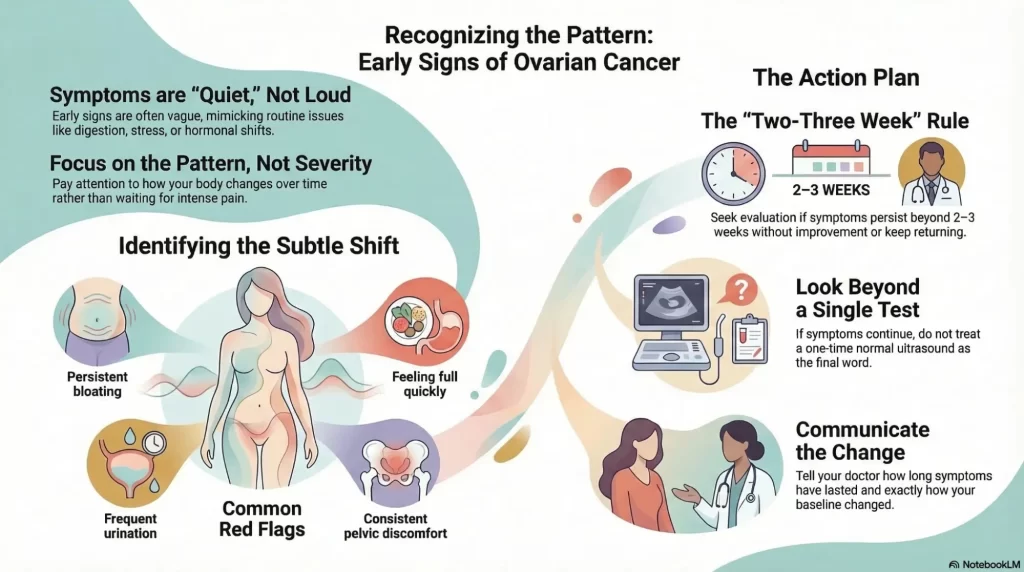
- You have persistent bloating that lasts weeks, not days
- You feel full quickly, even with small meals, more often than before
- There is a gradual increase in abdominal size without weight gain elsewhere
- You are experiencing frequent urination without infection
- There is a consistent, dull pelvic discomfort
None of this needs to be intense.
What matters is:
It is repeating and staying.
Why Routine Tests May Not Always Resolve the Doubt
Many patients feel reassured after one normal scan.
And that reassurance is understandable.
But I want you to look at this differently.
A normal ultrasound or test result is helpful.
But it does not always explain persistent symptoms, especially early on.
Because:
- Early findings can be subtle
- Some changes may not be clearly visible immediately
- Reports need to be interpreted along with your symptom pattern over time
So if your symptoms continue, don’t treat a normal report as the final answer.
Treat it as one part of the overall picture.
What Patients Often Get Wrong at This Stage
This is where I see the most confusion.
Many patients wait for:
- Severe pain
- Sudden worsening
Or they rely on:
- A single consultation
- One-time test results
And they assume:
“If something serious was there, it would have shown clearly.”
But ovarian cancer symptoms don’t usually follow that pattern.
What matters more is:
how your symptoms are evolving, not how intense they feel today.
When Should You Actually Take the Next Step?
You don’t need to panic.
But you do need clarity.
You should consider further evaluation if:
- Symptoms persist beyond 2–3 weeks without improvement
- They keep returning despite treatment
- There is a consistent shift in your daily comfort or body pattern
This is not overreacting.
This is simply moving from:
“I’ll wait a little more”
to
“I need a clearer understanding now.”
How to Approach the Next Step Without Overreaction
I always guide my patients in a simple way.
When you consult:
- Don’t just name the symptom
- Explain how long it has been happening
- Describe what has changed over time
This helps us evaluate properly.
If the pattern has been consistent, it is reasonable to:
- Consult a gynaecologist or a gynecologic cancer specialist
- Look at your symptoms in a more structured way
This step is not about assuming the worst.
It is about not ignoring a pattern that deserves attention.
A Final Thought I Want You to Keep in Mind
Most symptoms, such as bloating, appetite changes, or mild pelvic discomfort, turn out to be non-serious.
But persistence is something I never advise patients to ignore.
So instead of asking:
“Is this symptom dangerous?”
Ask yourself:
“Has something in my body changed in a way that is not going back to normal?”
That is the question that helps you decide what to do next.